Short cable runs or longer conduit routes for home EV chargers
Understanding the trade-off between direct cable paths and protected conduit routes
When planning a home EV charger, one of the early decisions involves how to get power from the electrical panel to the charging location. The simplest approach is a short, direct cable run, but property layouts and local requirements often make a longer conduit route the better choice. Understanding when each option works can save time, reduce disruption, and help avoid surprises during installation.
A short cable run means the charger sits close to the panel, often in the garage or on an exterior wall directly behind it. The cable stays exposed or runs inside a wall cavity, with minimal bending and no extra protective tubing. This setup keeps material and labor low, and it tends to be the fastest path to a working charger. For many homes, especially those with an attached garage and a panel mounted on the shared wall, this is the natural choice.
When a short cable run makes sense
A direct run works best when the panel and the intended charger location are on the same wall, or when the distance is under fifteen or twenty feet. The cable itself is rated for the application and can be secured along the wall surface or fished through studs and joists without needing additional conduit. This keeps the installation neat and avoids extra penetrations through floors or ceilings.
Another situation where a short run fits is when the charger will be mounted in a garage that already has the panel inside it. Many garages have the panel on an interior wall, and the charger can go on the same wall or the adjacent one. The cable route stays within the garage, so there is no need to trench through landscaping or run conduit across finished living spaces.
For homeowners who plan to sell or who want the lowest upfront cost, a short cable run is often the most straightforward option. It also simplifies future changes because the cable is easy to access and reroute if the charger is moved a few feet.
When a longer conduit route is necessary or beneficial
Many properties do not have the panel near where the charger is needed. If the panel sits in a basement, on the opposite side of the house, or in a detached structure, a direct cable run becomes impractical or impossible. In those cases, a conduit route allows the cable to travel through walls, under floors, or underground to reach the charger location.
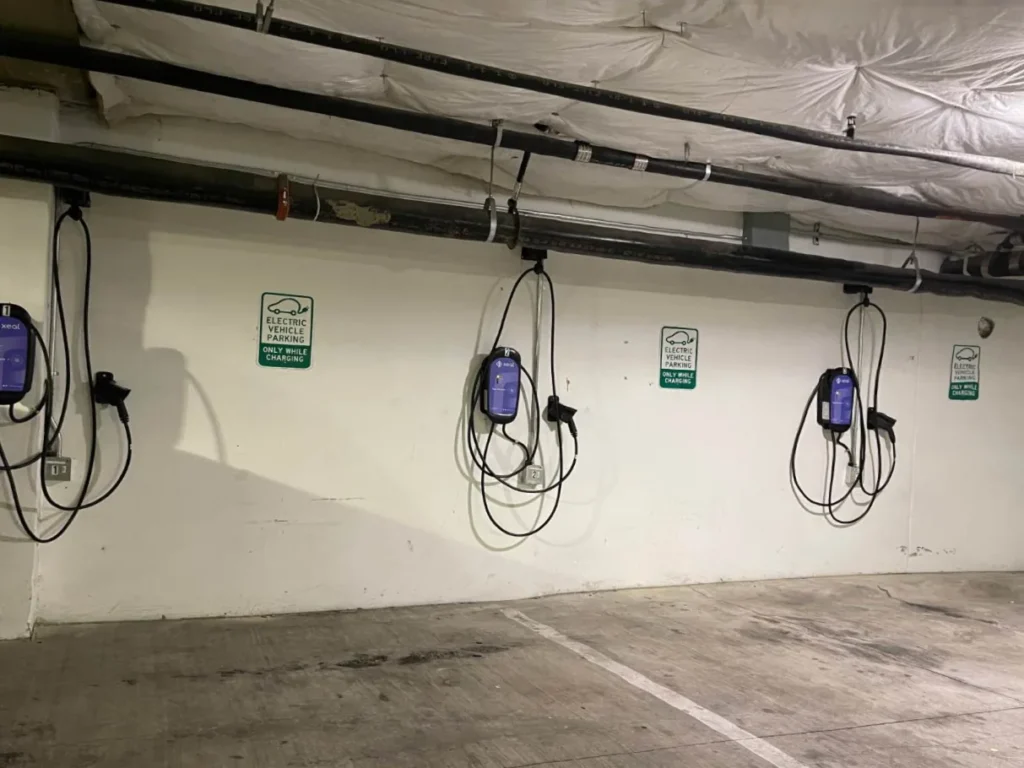
Conduit also provides mechanical protection. Where the cable passes through areas that could be bumped, exposed to moisture, or subject to physical damage, conduit shields it. This is especially relevant for outdoor runs, where the cable must be protected from weather, UV light, and accidental impact. Even indoors, conduit can be required by local code when the cable is exposed in a garage below a certain height or runs across a wall surface where it might be struck.
A longer conduit route also offers flexibility in charger placement. Instead of being forced to mount the charger near the panel, you can put it exactly where it is most convenient for your vehicle. That might mean a charger on the side of the house near the driveway, in a detached garage, or at a parking pad that is far from the main structure. The extra effort of running conduit opens up those options.
Permits, inspection, and property layout
In San Jose and the surrounding Bay Area, electrical work for EV chargers typically requires a permit and inspection. The permit process ensures that the installation meets current code, and the inspector will look at the cable routing, conduit use, and overall safety of the setup. A short cable run that follows code is straightforward to pass, but a longer conduit route may need more careful planning to satisfy requirements for burial depth, conduit fill, and support spacing.
Property layout plays a big role in the decision. A home with a finished basement, for example, might allow a conduit route to run along the ceiling joists and exit through an exterior wall, keeping the cable hidden. A slab-on-grade house, on the other hand, may require trenching through the yard or running conduit along the exterior, which adds labor and material. The soil type, existing landscaping, and the presence of sprinkler lines or other utilities all factor into whether a longer route is practical.
For many homeowners, the choice comes down to balancing convenience with cost. A short cable run is cheaper and faster, but it limits where the charger can go. A longer conduit route costs more upfront but can make the charger more usable in the long run. The right answer depends on your specific parking situation, the distance from the panel, and how much disruption you are willing to accept during the work.
If you are considering an EV charger installation San Jose, it helps to have a licensed electrician assess the property. They can measure the distance, check the panel capacity, and recommend a route that meets code and fits your budget. An on-site visit is the only way to see the exact path the cable will take and whether conduit is needed.

Conduit materials and routing options
Conduit comes in several types, and the choice depends on where it will be installed. Rigid metal conduit (RMC) is strong and often used outdoors, but it is heavy and takes more effort to bend and cut. Electrical metallic tubing (EMT) is lighter and easier to work with, and it is common for indoor or protected outdoor runs. For underground runs, schedule 40 or schedule 80 PVC conduit is the standard, as it resists corrosion and is rated for direct burial.
The route itself can take many forms. In a garage, conduit might run along the wall surface from the panel to the charger, with elbows to go around corners. For a detached garage, the conduit may exit the house, go underground, and come up at the charger location. The depth required for underground conduit is typically 18 inches for PVC and 6 inches for metal, though local amendments may vary.
Longer conduit runs also require careful attention to the number of bends. Code limits the total degrees of bend between pull points, usually to 360 degrees total. That means if the route has four 90-degree bends, you need a junction box or pull point to make the wire pulling manageable. Planning the route with this in mind avoids difficult installations and potential damage to the wire.
Utility connection and panel considerations
Before any cable or conduit is run, the electrical panel must have capacity for the new circuit. A typical EV charger needs a 40-amp or 50-amp breaker, and the panel must have space for that breaker and enough overall capacity to handle the added load. If the panel is full or undersized, the utility connection may need an upgrade, which is a separate project. That work is often done at the same time as the charger installation, and it can influence the cable route because the new panel location or service entrance might be different from the old one.
For homes with a smart meter or a time-of-use rate plan, the utility connection itself is usually straightforward, but the electrician will coordinate with the utility if a service upgrade is needed. The permit and inspection process covers the new circuit and any panel work, so the entire installation is verified for safety.
Making the choice for your property
There is no single right answer for every home. A short cable run works well when the panel is close to where you park. A longer conduit route is the solution when the charger needs to be in a different location, or when code requires protection for the cable. Both options can be installed safely and look clean when done by a qualified electrician.

For a homeowner in San Jose, the decision often comes down to the layout of the garage and driveway. If the panel is in the garage and you park inside, a short run is likely the best fit. If you park in a driveway or on the street, or if the panel is in a basement or on the opposite side of the house, a conduit route that goes through the wall and underground or along the exterior may be necessary.
When you schedule an EV charger installation San Jose, the electrician will walk through the options with you. They will look at the panel location, the parking spot, and the path the cable must take. They will also factor in the permit requirements and any utility connection work that might be needed. The goal is to give you a charger that works reliably and looks good, without unnecessary cost or disruption.
Thinking about the trade-offs now, before the work begins, helps you ask the right questions and understand the quotes you receive. Short runs are simple and low-cost. Longer conduit routes take more planning but can put the charger exactly where you want it. Either way, the installation should be done to code, with a permit and inspection, so you know the system is safe and ready for years of use.